Facebook

WELCOME TO OUR BLOG

We're sharing knowledgein the areas which fascinate us the most
click

How to match the engine, gearbox and propeller in the most reasonable way?

By Ruby December 21st, 2022 2034 views
How to match the engine, gearbox and propeller in the most reasonable way?
Today, I will talk about the matching of the propeller and the machine. Although this matter is the work of a design institute or a shipyard, you better understand a little bit.

Now generally large ships use heavy-duty low-speed marine diesel engines as propulsion power.
Image
Small and medium ships, generally, medium and high-speed marine diesel engines are used. Especially fishing boats, without exception, are medium and high-speed diesel engines.

In order to improve propulsion efficiency, these medium and high speed machines all pass through the reverse reduction gearbox. After reducing the speed of the diesel engine, it is transmitted to the propeller.

Image

The ship relies on the power from the main engine through a series of transmissions (reduction gearbox, shafting) to drive the propeller to rotate, and generate thrust to propel the ship forward.
Ships, main engines (reduction gearboxes), propellers. The matching of the three directly affects the speed of the ship,the efficiency of the propeller, how much fuel consumption (economy), and host life and other performance.
In order to illustrate this problem, several concepts must be clarified:

1. Host power
For the main engine of the ship, the maximum power of the main engine of the ship under the rated speed, within the specified normal maintenance period of the main engine, and under standard environmental conditions, is regarded as the continuous power or rated power.

If the factory-calibrated power of the main engine is not the rated power under the marine standard environment, it should be corrected according to the marine standard environment in actual use.
From the perspective of power plant design, considering the economy and maintenance of the main engine, it is generally necessary to leave a margin for the power of the main engine, so that the main engine can adapt to the power reduction due to long-term operation, and the pollution and deformation of the ship after long-term use. Factors such as the swaying and turbulence of the ship in the wind and waves.
For general transport ships, a 10% margin is often selected;
For heavy load conditions such as fishing boats and tugboats, a 15% margin is often selected.
The power after deducting this margin can be used as the usual power.

2. Propeller received power:
The power emitted by the main engine can only be transmitted to the propeller through the reverse reduction gearbox, intermediate shaft, propeller shaft, etc. Gearboxes, shafting, etc. will lose a part of power due to friction loss, and accessories such as the transmission oil pump of the gearbox itself will also lose a part of power. These are called transmission efficiency.
Image

3. Main engine rated speed:
It is the speed at which the diesel engine emits the rated power for continuous operation under standard ambient conditions.

4. Trial speed:
When the ship is on trial, in calm sea, the wind force is not greater than Beaufort level 2, deep water channel, and the average speed of the forward and reverse horizontal speed at the rated speed of the main engine.

The above concepts are clarified, we can then discuss how to match the ship, engine and paddle.

For general ships, the lower the speed of the propeller, the larger the diameter, the more efficient the propeller.
Therefore, ships with medium and high-speed diesel engines as the main engine are generally used. The speed of the propeller must be reduced by means of a reduction gear box, in order to increase the diameter of the propeller.

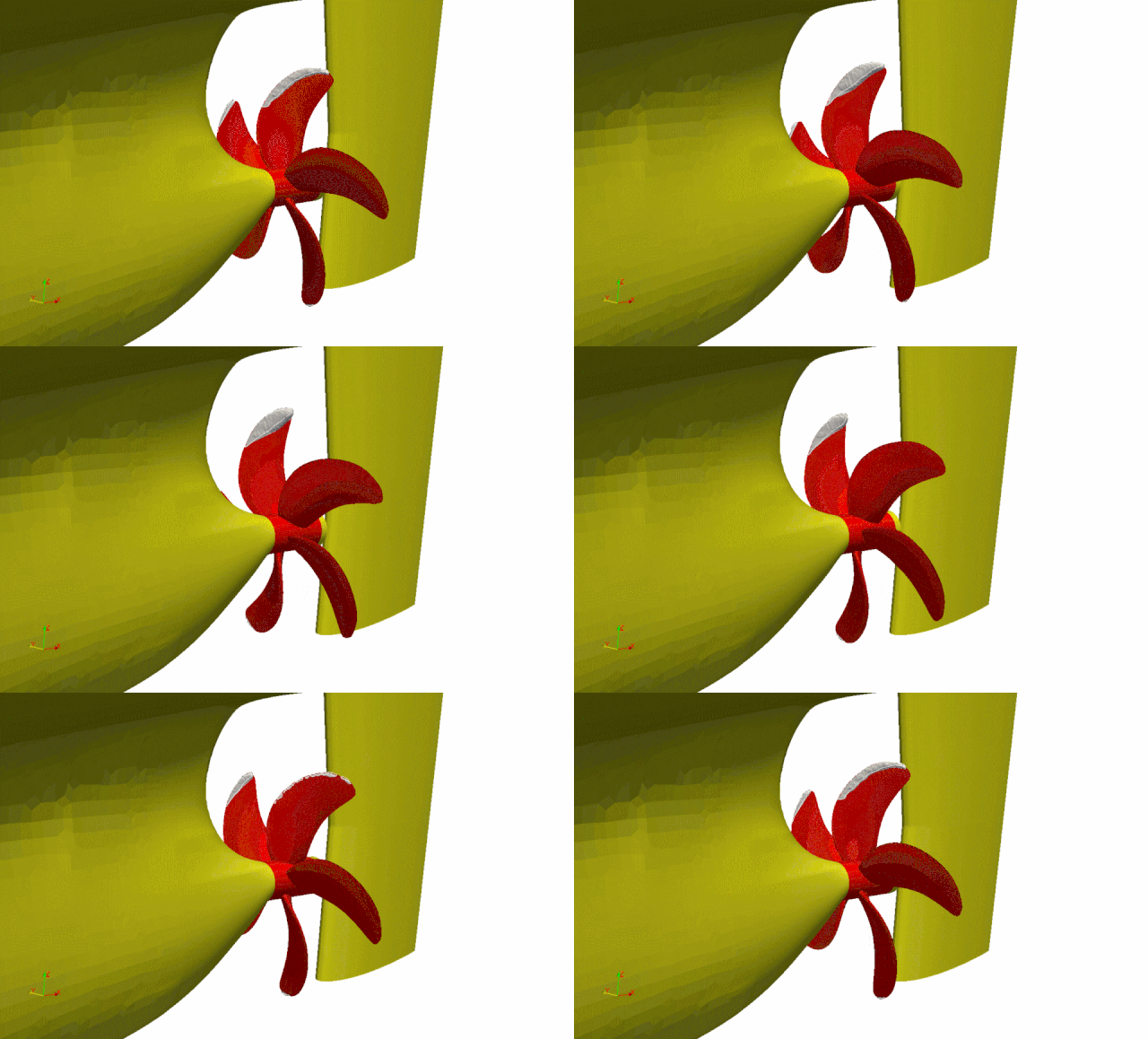
But this is not absolute. The diameter of the propeller cannot be increased blindly. There should be a certain appropriate gap between it and the hull. If the gap is too small, the hull will vibrate and affect the normal operation of the equipment. Seriously, it even affects the structural strength of the hull, and the welds are cracked.

For a certain ship, main engine power, and propeller speed, there is an optimal diameter with the highest efficiency. Generally, when designing a propeller, the optimal diameter is selected for design. Sometimes the optimal diameter is too large, and the optimal diameter cannot be used due to the limitation of the hull structure, draft, etc., so the "limited diameter" should be used for design. If the "limited diameter" is not much different from the optimal diameter and has little effect on the efficiency, the "limited diameter" can also be used for design. If the difference is large and the propeller efficiency is greatly reduced, the optimal propeller speed should be selected under the condition of the maximum diameter allowed by the structure to improve the propeller efficiency.

Now, some people think that the larger the reduction ratio of the gearbox, the better, some fishing boats have used 9.5:1-12:1. After all, fishing boats have smaller hulls than cargo ships, the draft is shallow and the propeller diameter is limited. Blindly increasing the reduction ratio not only increases the cost of the reduction box, but also cannot achieve the best propeller efficiency. Therefore, no matter what kind of ship, it is best to choose the optimal diameter and optimal speed of the propeller in the preliminary design stage of the ship.

Under the conditions allowed by the stern structure, select the largest propeller diameter, and then select the optimal rotation speed under this diameter, so as to determine the gearbox speed ratio.
We have to deal with ship design institutes and shipyards during shipbuilding. Professional engineers will give you the most reasonable plan for how to calculate it.
Ship Knowledge——Main equipment accessories of ships (part 2)
Previous
Ship Knowledge——Main equipment accessories of ships (part 2)
Read More
Next
Foreign trade salesman, are you upset?
Read More

ARE YOU READY TO WORK WITH US?

Contact US