Anchor equipment is one of the most critical safety systems onboard a vessel. It ensures safe anchoring operations, protects ships during mooring, and plays a vital role in emergency situations. Proper testing, inspection, and maintenance of anchors, anchor chains, windlasses, and related systems are essential for safe navigation and compliance with maritime regulations.
This article introduces the testing procedures, inspection standards, and maintenance methods for marine anchor equipment.
1.1 Anchor Testing
Before anchor testing begins, the anchor must undergo:
- Visual inspection
- Weight verification
- Dimensional inspection
The inspection should be completed before painting.
Surface Quality Requirements
The anchor surface must be free from:
- Cracks
- Porosity
- Sand holes
- Other defects affecting strength
Minor defects may be repaired by approved welding methods.
Weight Tolerance
The allowable weight deviation for a complete anchor is:
However, the total actual weight of the ship’s bow anchors must not be lower than the required classification standard.
Anchor Shank Straightness
The bending deformation of the anchor shank shall not exceed:
Anchor Fluke Rotation Angle
Permissible deviation:
Dimensional Tolerance
When the weight meets requirements, dimensional tolerance is:
- ±4%
- Maximum deviation not exceeding ±20 mm
1.2 Anchor Pull Test
According to GB/T548-1996 standards, anchors weighing more than 75 kg must undergo pull testing.
Test Method
- One end of the force is applied at the anchor shackle.
- The other end is applied at one-third distance from the fluke tip.
- Measurement marks are made for distance checking.
For stockless anchors:
- Both flukes are tested simultaneously.
- Tests are performed on both sides.
Loading Procedure
- Gradually increase load to 10% of test load
- Maintain for 5 minutes
- Measure the distance between reference marks
Acceptance Criteria
The anchor passes if:
- Distance variation after two tests does not exceed 20 mm
- Flukes rotate freely to maximum angles
If defects remain after retesting, the anchor shall be rejected.
Approved Anchor Markings
Qualified anchors are stamped with:
- Anchor weight
- Standard number
- Manufacturer mark
- Test date
- Classification approval mark
- Vessel inspection certificate number
2.1 Welded Anchor Chain Testing
Breaking Load Test
Three connected chain links are tested together.
The chain passes if:
- No fracture occurs under specified breaking load
Proof Load Test
After breaking load testing:
- Every chain link must undergo proof load testing
Inspection includes:
- Surface quality examination
- Length measurement under 10% proof load
Elongation Requirement
Length increase of five adjacent links shall not exceed:
Replacement Rules
Damaged or excessively deformed links must be replaced.
If replaced links exceed:
the entire chain section must be rejected.
2.2 Mechanical Property Test (Grade M3 Chains)
For every chain section not exceeding 27.5 m:
- One tensile specimen
- Two sets of Charpy V-notch impact specimens
are taken for mechanical testing.
Test results must comply with national standards.
Qualified chain markings include:
- Manufacturer code
- Chain grade
- Size specification
- Classification society mark
- Certificate number
2.3 Cast Steel Anchor Chain Testing
Breaking Test
Three connected links are selected for testing.
If failure occurs:
- Another sample set is tested
If the second test also fails:
- The chain section is rejected
Proof Load Test
During testing:
- Chain alignment must remain correct
- Twisting is not allowed
The test load is maintained for approximately:
Residual elongation after testing shall not exceed:
3. Windlass Testing
Windlass testing consists of:
- Factory testing
- Mooring testing
- Sea trial and anchoring testing
3.1 Factory Testing
No-Load Test
For electric windlasses:
- High-speed forward/reverse operation: 15 minutes each
- Total high-speed operation: 30 minutes
- 25 starts during 30 minutes
For hydraulic windlasses:
- Continuous forward/reverse operation for 1 hour
- Direction changed every 3–4 minutes
Inspection Items
Check:
- Motor operation
- Brake performance
- Clutch reliability
- Emergency stop systems
3.2 Load Test
The windlass operates under:
- Rated load for 30 minutes
- Overload condition for 2 minutes
Inspection includes:
- Foundation condition
- Bolts
- Chain wheel shaft
- Brakes
- Clutches
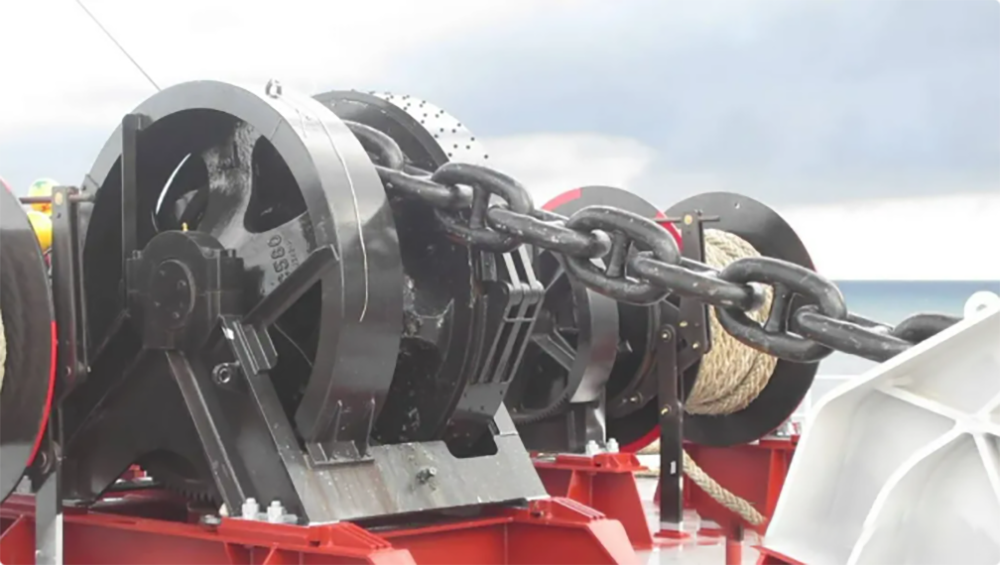
4. Mooring and Sea Trial Testing
4.1 Mooring Test
Inspection Items
- Electrical connections
- Lubrication condition
- Empty running operation
Anchor Dropping and Hoisting Test
Each anchor is:
- Dropped independently
- Braked 2–3 times during release
- Hoisted with intermittent stopping
Check for:
- Smooth chain movement
- No chain jumping or twisting
- Normal gearbox and bearing temperature
4.2 Sea Trial and Anchoring Test
Typical water depth:
Brake Test Requirements
When braking during chain release:
- Half-shackle release: chain sliding ≤ 2 m
- After 1 shackle: sliding ≤ 3–4 m
- After another shackle: sliding ≤ 4–5 m
Hoisting Speed Requirement
The windlass must lift a single anchor from:
- 82.5 m depth to 27.5 m depth
at an average speed of:
5. Daily Inspection and Maintenance
5.1 Anchor Maintenance
Check:
- Anchor shackle wear
- Pin looseness
- Fluke rotation flexibility
During hoisting:
- Remove debris from flukes
- Slow down before anchor contacts hull
5.2 Anchor Chain Maintenance
Daily Practices
- Alternate port and starboard anchor use
- Maintain clear chain markings
- Lubricate swivel joints regularly
Chain Wear Inspection
Monitor:
- Link deformation
- Cracks
- Corrosion
- Structural looseness
5.3 Windlass Maintenance
Operational Requirements
- Follow correct operating procedures
- Avoid excessive starting frequency
- Monitor motor current carefully
Lubrication
- Lubricate before operation
- Maintain clutch flexibility
- Inspect gear and worm thread wear
Brake Inspection
Frequently inspect:
- Brake reliability
- Friction surface condition
6. Periodic Inspection
Anchor equipment should undergo full inspection at least every six months.
Inspection Includes
Anchor
- Surface inspection
- Fluke angle movement
- Hull fitting condition
Anchor Chain
- Wear and deformation
- Chain markings
- Loose structures
Windlass
- Detailed inspection of all operating components
- Lubrication system checks
- Brake system inspection
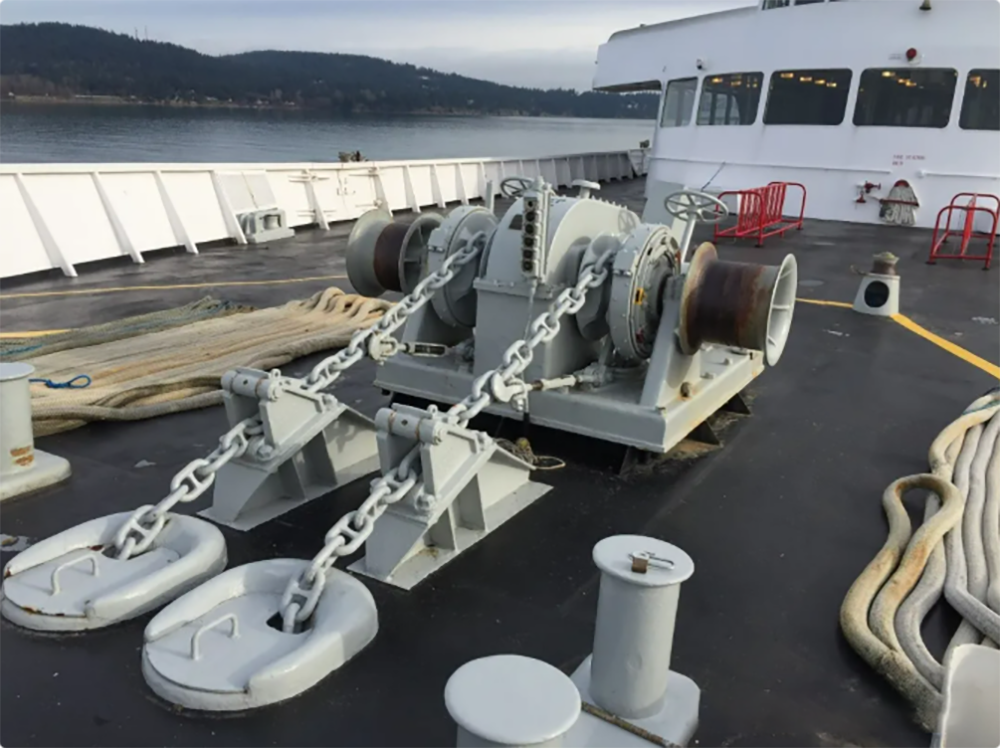
7. Dry Dock and Major Repair Inspection
7.1 Anchor Overhaul
Inspect:
- Shank deformation
- Fluke wear
- Crown pin condition
Anchor weight loss shall not exceed:
7.2 Anchor Chain Overhaul
The entire chain should be:
- Removed from chain locker
- Cleaned
- Rust removed
- Repainted
Crack Detection
Each chain link is checked by hammer sounding.
Wear Measurement
If link diameter is below:
the link must be replaced.
Structural Inspection
Check:
- Stud looseness
- Pin movement
- Lead seals
During major overhaul:
- End links are reversed
- Pins and seals replaced
7.3 Windlass Overhaul
Check alignment of:
- Chain wheel
- Chain stopper
- Guide roller
- Hawse pipe
Gear tooth wear shall not exceed:
- 10% of original thickness
7.4 Chain Locker Maintenance
When the chain is removed:
- Clean the chain locker thoroughly
- Inspect drainage system
- Repair damaged lining
- Repaint if necessary
- Inspect hawse pipe wear
Marine anchor equipment is essential for vessel safety, operational efficiency, and regulatory compliance. Proper testing, regular inspection, and preventive maintenance greatly reduce the risk of anchoring accidents, chain failure, and windlass malfunction.
By implementing systematic maintenance procedures and periodic inspections, shipowners and operators can extend equipment service life, improve operational reliability, and ensure safe anchoring operations under all sea conditions.
For shipyards, vessel operators, and marine equipment suppliers, maintaining anchor systems to classification standards is not only a technical requirement but also a critical investment in maritime safety.