Marine windows are not just “glass on a ship.”
They are critical safety components designed to withstand waves, pressure, vibration, salt corrosion, and even fire in some applications.
If a marine window fails at sea, it can lead to water ingress, equipment damage, or serious safety risks for the crew. That is why professional testing is required before marine windows are approved for vessel installation.
In this article, we explain how marine windows are tested for safety, what standards are involved, and what shipowners and shipyards should pay attention to before purchasing marine windows.
Ships operate in one of the harshest environments on earth.
Marine windows must continuously resist:
Strong seawater corrosion
Wind and wave impact
Hull vibration
Temperature differences
UV exposure
Heavy rain and pressure
Long-term fatigue during navigation
Unlike ordinary building windows, marine windows must maintain watertight integrity and structural strength even in rough sea conditions.
For this reason, classification societies and international marine standards require strict testing before windows can be certified for vessel use.
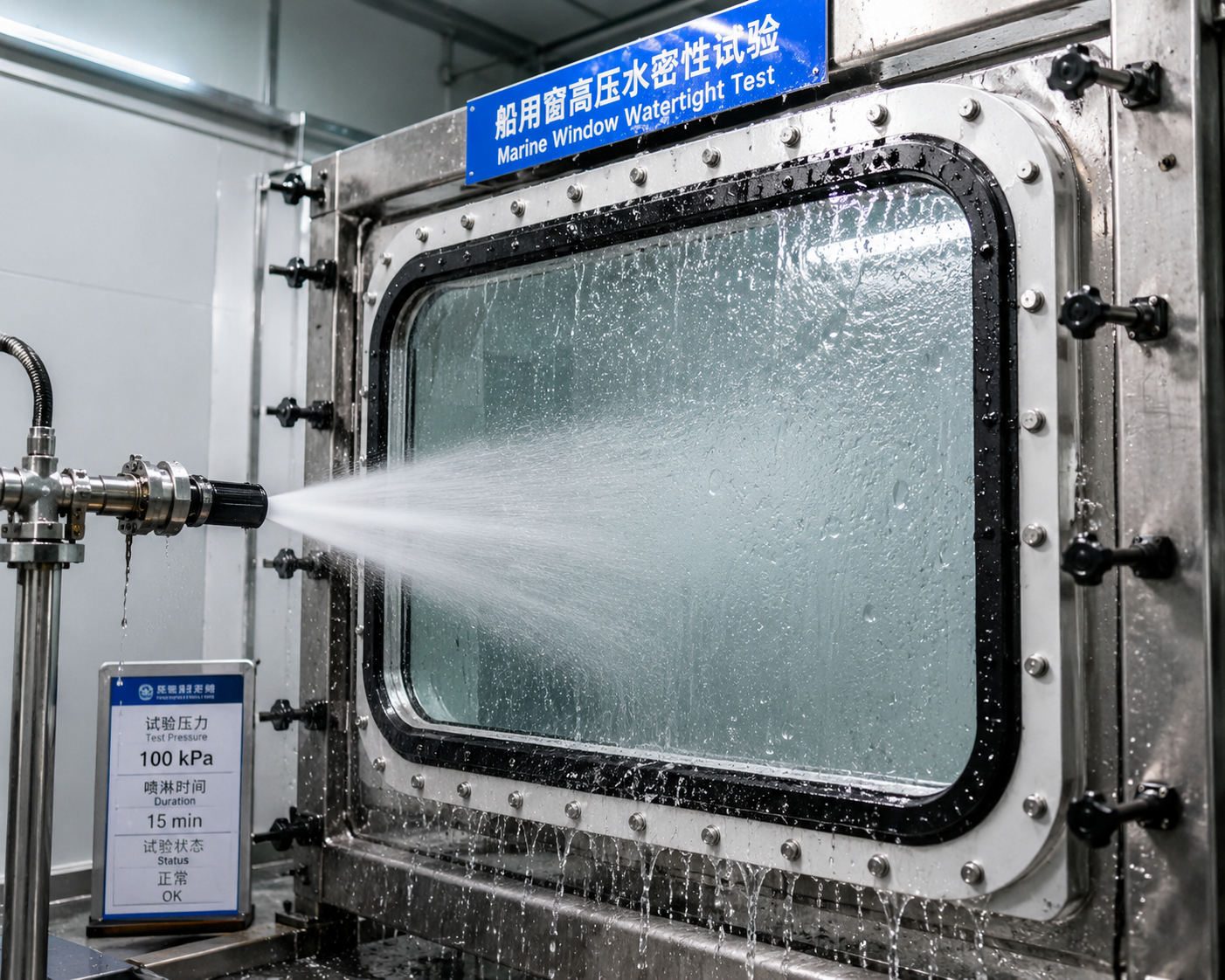
The watertight test is one of the most important marine window inspections.
The purpose is to verify that no water enters the vessel during heavy rain, wave impact, or high-pressure washing.
High-pressure water is sprayed directly onto the marine window from different angles for a specified period.
Engineers then inspect:
Frame sealing condition
Rubber gasket performance
Leakage points
Drainage performance
Poor sealing may cause:
Cabin flooding
Corrosion inside the vessel
Electrical equipment damage
Mold and humidity problems
For offshore vessels and fishing boats operating in rough seas, watertight performance is especially critical.
Air tightness testing checks whether outside air can penetrate through the window structure.
This test is important because air leakage can affect:
HVAC efficiency
Cabin comfort
Noise insulation
Energy consumption
The window is mounted in a test chamber.
Pressure differences are applied between the inside and outside surfaces.
Technicians measure the amount of air leakage under different pressure levels.
Marine windows must withstand continuous sea pressure and vessel movement.
During this test, engineers simulate external pressure loads to ensure the window does not deform or crack.
Uniform pressure loading
Structural deformation inspection
Glass stress evaluation
Frame strength checking
This is especially important for:
Wheelhouse windows
Offshore platform windows
High-speed vessels
Tugboats
Naval support vessels
In real marine operations, windows may be hit by:
Heavy waves
Loose deck equipment
Cargo movement
Tools during maintenance
Impact testing verifies whether the glass and frame can resist sudden force.
Pendulum impact testing
Steel ball drop testing
Mechanical strike simulation
Laminated safety glass is commonly used because it reduces dangerous glass fragmentation after impact.
Some marine windows are installed in fire-rated zones.
In these cases, fire resistance testing is required.
The window assembly is exposed to high temperatures for a specified duration.
Engineers evaluate:
Flame penetration
Heat insulation
Structural integrity
Smoke leakage
Fire-rated marine windows are often required on:
Passenger ships
Cruise vessels
Offshore platforms
Engine control rooms
Saltwater is highly corrosive.
Marine window frames, hinges, bolts, and accessories must survive long-term exposure to seawater and humidity.
Salt spray testing is commonly performed.
Components are placed inside a salt fog chamber for hundreds of hours to evaluate:
Rust formation
Surface coating performance
Material durability
Aluminum alloy and stainless steel frames are widely used because of their corrosion resistance.
Ships continuously vibrate during engine operation and navigation.
Over time, vibration can loosen bolts, damage seals, or create fatigue cracks.
The marine window assembly is mounted onto vibration equipment that simulates vessel operating conditions.
The test checks:
Structural stability
Fastener reliability
Seal durability
Glass fixation safety
Several international organizations and classification societies regulate marine window safety.
These may include:
IMO standards
ISO marine standards
CCS
BV
DNV
ABS
LR
KR
Different vessels and regions may require different approvals.
Before purchasing marine windows, shipowners should always confirm the required certification standard with the shipyard or classification society.
Advantages:
Lightweight
Corrosion resistant
Easy maintenance
Cost-effective
Widely used on:
Fishing boats
Cargo ships
Tugboats
Workboats
Advantages:
Higher strength
Better corrosion resistance
Premium appearance
Commonly used on:
Luxury yachts
Offshore vessels
Passenger vessels
Provides:
Higher impact resistance
Better crew safety
Reduced fragmentation risk
Windows for inland river vessels are different from windows for offshore ships.
Sea condition directly affects design requirements.
Some projects require:
CCS certificate
CE approval
Fire rating
Specific pressure testing
Late confirmation may delay delivery.
Even certified marine windows can leak if installed incorrectly.
Proper installation includes:
Correct sealant usage
Accurate frame alignment
Proper bolt torque
Drainage inspection
At SINOOUTPUT, we support shipyards, vessel owners, and marine contractors with reliable marine window solutions for both newbuilding and retrofit projects.
Our marine window solutions can include:
Fixed marine windows
Wheelhouse windows
Sliding windows
Hinged windows
Weathertight windows
Fire-rated marine windows
We also assist customers with:
Technical drawing confirmation
Window size customization
Material selection
Certification support
Matching marine doors and hatches
With experience supporting different vessel types worldwide, SINOOUTPUT helps customers reduce procurement risk and improve project efficiency.
Marine windows are specially designed for ship environments. They must resist seawater corrosion, pressure, vibration, and impact.
Not always.
Certification requirements depend on vessel type, operating area, and classification society requirements.
Tempered glass and laminated safety glass are commonly used because of their higher strength and safety performance.
Common reasons include:
Improper installation
Aging rubber seals
Structural deformation
Incorrect maintenance
Yes.
Marine windows are often customized according to:
Vessel structure
Window opening size
Pressure requirements
Certification requirements
Marine window safety testing is essential for protecting vessels, equipment, and crew members at sea.
From watertight testing to impact resistance and fire protection, every test helps ensure the window can survive real marine operating conditions.
Choosing properly tested and certified marine windows can reduce maintenance risks, improve vessel safety, and support long-term reliable operation.
If you are planning a shipbuilding or vessel retrofit project, working with an experienced marine equipment supplier like SINOOUTPUT can help simplify the technical selection and certification process.