Names of various parts of a ship
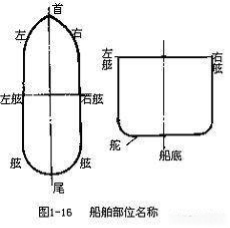
The names of the various parts of a ship are shown in the diagram. The front of the ship is called the bow; the rear is called the stern; the bends in the hull plating on either side of the bow are called the bow; the bends in the hull plating on either side of the stern are called the quarter; the two sides of the ship are called the ships' sides; the bend where the ships' sides meet the hull is called the bilge.
The straight line connecting the bow and stern is called the fore and aft line (center line, center line). The fore and aft line divides the hull into two halves, port and starboard. Looking forward from the stern, the side to the right of the fore and aft line is called the starboard side; the side to the left is called the port side. The direction perpendicular to the midpoint of the fore and aft line is called the beam; the beam on the port side is called the port beam; the beam on the starboard side is called the starboard beam.
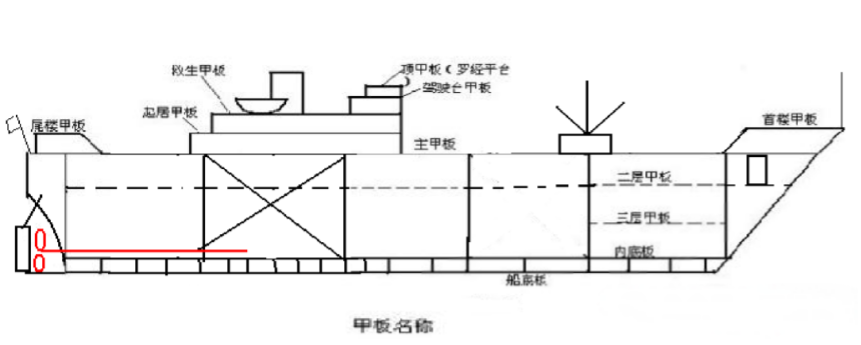
The horizontally arranged steel plates on a ship's hull are called decks, which divide the hull into several layers. The uppermost deck, running from bow to stern, is called the upper deck. If all openings on this deck are watertight, it is also called the main deck, and in measurement, it is referred to as the tonnage deck.
Some ocean-going vessels have an additional upper deck running from bow to stern above the main deck; since its openings cannot be watertight, it is simply called a shelter deck.
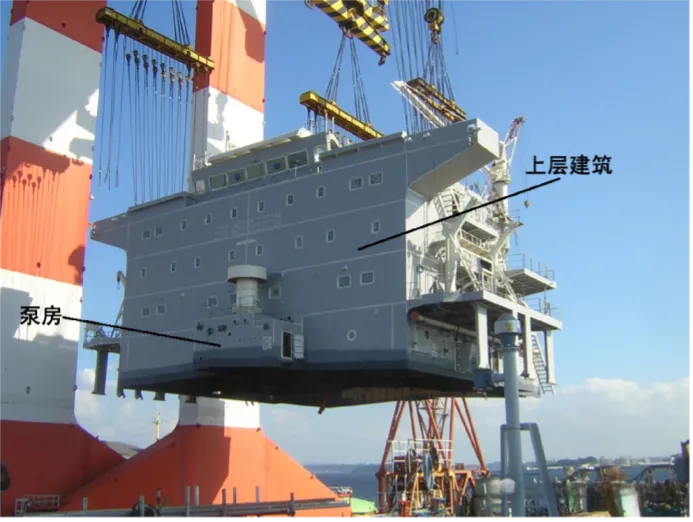
The main deck divides the ship into two parts: the portion above the main deck is collectively called the superstructure; the portion below the main deck is called the hull.
The horizontally arranged steel plates below the main deck are called the second deck, third deck, etc., from top to bottom. All decks above the main deck are short sections, conventionally named according to the cabins or uses within that deck, such as the bridge deck, lifeboat deck, etc.
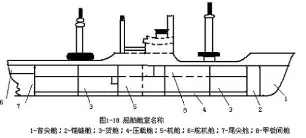
Within the main hull, transverse bulkheads divide the ship into numerous compartments of varying sizes, each named according to its purpose or location, as shown in Figure 1-18. From bow to stern, these are called the forepeak, anchor chain compartment, cargo hold, engine room, aft peak, and ballast tank. The space between two decks in the cargo hold is called a two-deck deck, also known as a second deck or second-level container.
The superstructure is divided into two main types: the superstructure and deckhouses. A superstructure extends to or is very close to the ship's sides on both sides; a deckhouse is a superstructure that does not extend close to the ship's sides on either side. Superstructures are further divided into the forecastle, poop, and bridge. The compartments within the superstructure are generally named according to their purpose.
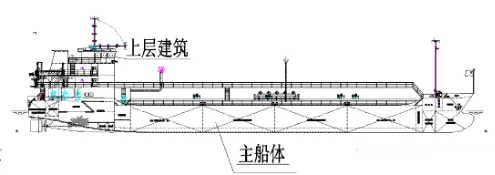
 Basic structure of the hull
The hull is composed of components such as deck, side plating, bottom plating, keel, side keels, keel reinforcements, ribs, bowpost, and sternpost. The actual hull structure of a ship is extremely complex.
① Keel
The keel is a longitudinal member connecting the bow and sternpost at the center of the hull's base. It primarily bears the longitudinal bending moment of the hull. When making a ship model, it should be made from rectangular strips of pine wood with straight grain and no knots.
② Side Keels
Side keels are longitudinal members located on either side of the keel. They bear part of the longitudinal bending moment and increase the hull's strength against external forces. Side keels on ships are commonly made from rectangular strips of pine wood.
③ Ribs
Ribs are transverse members within the hull. They bear transverse water pressure and maintain the hull's geometry. Ribs on ship models are commonly made from plywood.
④ Straps
Struts are longitudinal members on either side of the hull. Together with the ribs, they form a mesh structure to secure the side plates and increase the ship's structural strength. Straps on ship models are also typically made from rectangular strips of pine wood.
⑤ Hull Plates
Hull plates include the side plates and the bottom plate. The geometry of a ship's hull is determined by the shape of its hull plating. The various external forces acting on the hull, such as longitudinal bending forces, water pressure, and wave impacts, primarily act on the hull plating. The hull plating of a ship model can be made by splicing and gluing together pine strips and planks.
⑥ Bilge Keel
Some hulls are also equipped with bilge keels, which are longitudinal structural members installed at the junction of the sides and bottom of the ship. They reduce the rolling and swaying of the ship when sailing in waves. The bilge keels of a ship model can be made from copper or iron sheets with a thickness of 0.5-1 mm.
⑦ Foreposts and Sternposts
The foreposts and sternposts are installed at the bow and stern of the hull, respectively, and are connected to the keel below. They enhance the hull's ability to withstand wave impacts and water pressure, and also withstand longitudinal collisions and vibrations from propeller operation.
Ship Structure
Ships are tools of maritime transportation. Although ships vary in size, their main structural components are largely similar. A ship mainly consists of the following parts:
① Hull
The hull, the outer shell of the ship, is made by riveting or welding together multiple steel plates. It includes the keel plating, curved outer plating, and upper hull plating.
② Frame
The frame refers to the collective term for all materials used to support the hull, divided into longitudinal and transverse members. Longitudinal members include the keel, bottom frame, and side frame; transverse members include ribs, beams, and bulkheads.
③ Deck
The deck is a steel plate laid on the beams, dividing the hull into upper, middle, and lower layers. Large ships can have six or seven decks. Its function is to reinforce the hull structure and facilitate layered loading and cargo arrangement.
④ Holds and Tanks
Holds and Tanks refer to the various spaces below deck, including the foreboard hold, stern hold, cargo hold, engine room, and boiler room.
⑤ Superstructure
Superstructure refers to the structures above the main deck, providing living quarters and storage for the crew. It includes the foreboard cabin, stern cabin, and bridge.